
IHP Open Assembly Design Kit (ADK)
Current Status: Preview Release
Warning
The IHP Open ADK is a preview release. The interposer process has been fabricated several times at IHP, which is a statement about process maturity, not about a complete assembly. The kit is not intended for production assembly design at this moment.
Warning
This documentation is a work in progress. Pages describing future domains state directions, not shipped features.
What the ADK is
The Assembly Design Kit sits one abstraction layer above all PDKs. It owns the rules and tooling that govern how chiplets are placed and connected on an interposer. The interposer and the chiplet dies remain ordinary PDKs, each owning its own fabrication rules.
Keeping the PDK’s question and the ADK’s question apart is what lets one assembly rule deck check assemblies built on any interposer. What the ADK is draws the distinction in full.
Assembly-level verification is therefore a layer of its own, above the signoff each die and each interposer already runs in its own PDK, and it has two axes that do not subsume each other. The geometric axis, assembly DRC, is what this preview release ships. The connectivity axis is in scope for the ADK and is not part of this preview release. What the ADK is sets out both.
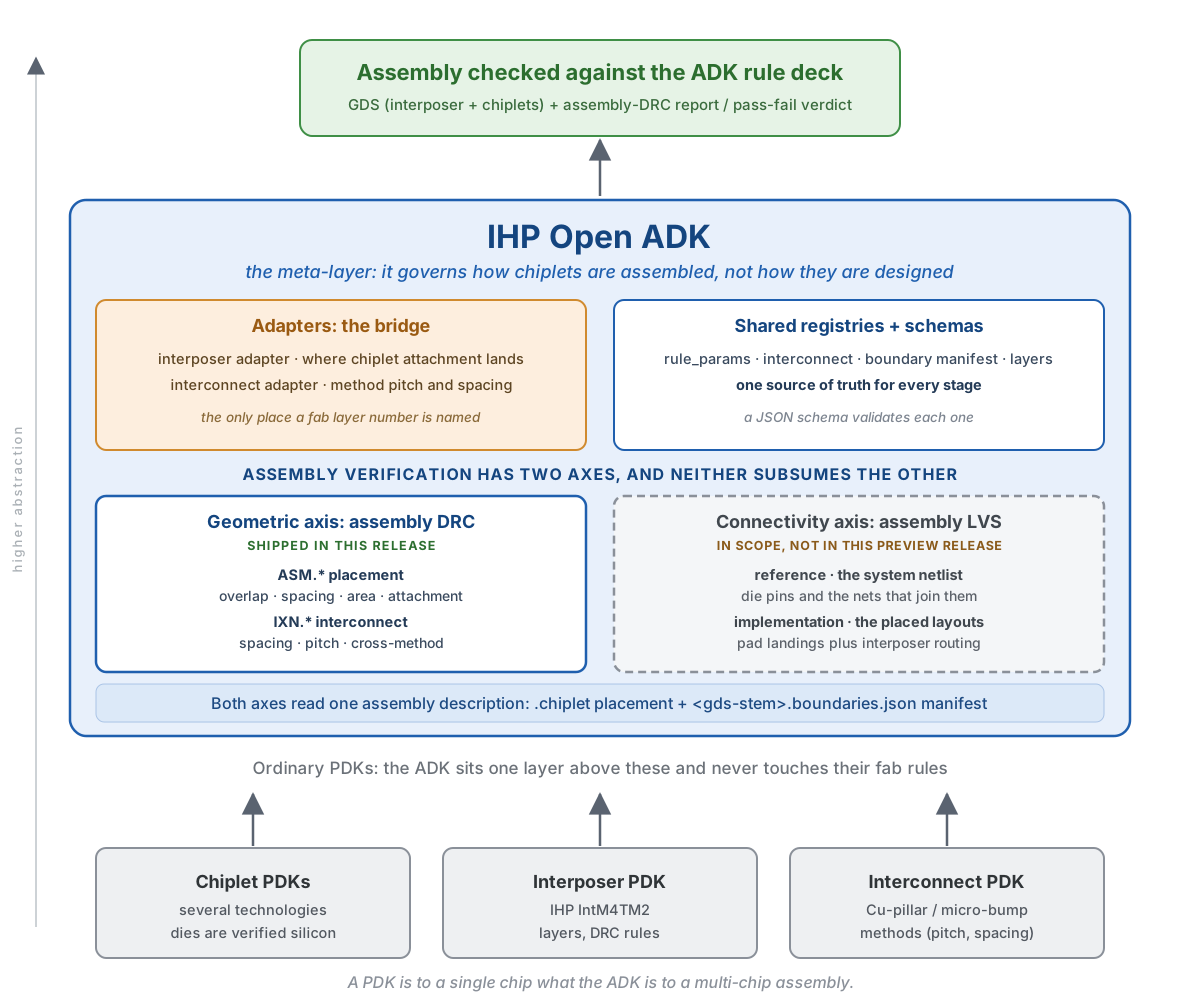
One assembly rule set above many PDKs. The chiplet PDKs, the interposer PDK and the interconnect PDK each own their own fabrication rules; the ADK owns only what happens between them, and reaches each one through an adapter.
Where to start
If you want to |
Read |
|---|---|
Get running in four commands |
|
Understand the problem and the approach |
|
Get a working toolchain |
|
Follow the flow end to end |
Overview, then Reference design |
Check an assembly |
|
Support a new interposer or bumping vendor |
|
Read or write the interchange files |
The .chiplet assembly file and Components and optional blocks |
Look up a term |
The ecosystem in one line
Die GDS becomes KiCad symbols and footprints, the interposer is authored in a
nanometre-capable KiCad fork, the board is exported as a .chiplet assembly
plus a HyperLynx netlist, the netlist becomes a fabrication-ready GDS, the
assembly is checked by the ADK rule decks, and the result is inspected in 3D.
The ecosystem names every repository and what it owns.
Scope of this documentation
This site documents the published preview: the ADK itself, the tools bundled in the ADK-Tools image, the interchange formats, and the reference design. Work in progress that is not part of the release, including the connectivity axis described above, is stated as a direction with no interface commitment, and Roadmap collects it.
Other open work is active in the same space and is complementary rather than competing. The gap it closes sets out where the ADK fits alongside it.
License
The ADK, the interposer PDK, the interconnect PDK and the chiplet format
specification are Apache-2.0. The KiCad fork, the KiCad plugin, gds2kicad,
Chiplet Studio and the ADK-Tools glue are GPL. The ecosystem carries
the per-repository breakdown, and the ADK-Tools image ships a NOTICE.md with
the per-component licence breakdown and the corresponding-source obligation.